

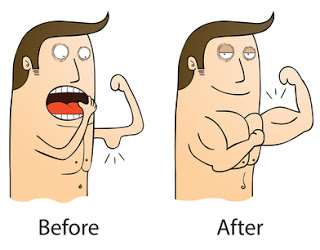
When a young man starts lifting weights, images of a swollen, muscular, lean version of himself floats in the mind like a balloon, reinforced by magazine covers (back in my day), Instagram pictures, YouTube videos and the plethora of internet sites devoted to fitness and muscular development. Soon enough, the young man starts to wonder: how big can I get? There are various ways to try to quantify this with things like the Fat Free Muscle Mass Index, and the Casey Butts method of taking measurements of things like wrist circumference and other joints to try to estimate how much muscle one’s body can support. Armed with this information, the young man, if dedicated, pursues every means possible to reach this maximum muscular potential.
As has often been joked, if you aren’t satisfied with how big, strong and muscular you have become after years of dedication to the iron, you should have picked better parents. The genetic component is the crucial one, and one over which our young lifting devotee has no control. The reality is, once you’ve exposed your body to resistance exercise, it will respond by adding new muscle to your frame. It’s a fairly immediate response which leads to the phenomenon known as newbie gains. These gains slow to a crawl fairly quickly requiring more effort to get less and less improvement.
My personal experience is very similar and I’ve devoted significantly more time than one might consider reasonable attempting to reach that illusive maximum muscular potential. It would be ridiculous to even consider that it might take decades to reach this goal, but I continue to try anyway. After dieting to a fairly lean level of body fat, I’ve found that my FFMI is just under 22, which as I’ve written about previously, is pretty good. But my FFMI has been the same for many, many years. All of the efforts I’ve made have essentially just maintained the muscle I built many years ago. How long ago did I stop growing? I think I may have an answer.
Somewhere around 2007 or 2008, I started focusing on powerlifting training. The whole point is to improve the maximum amount I can squat, bench press and deadlift for 1 repetition. While there is some time devoted to hypertrophy training in most powerlifting programs, it’s not the primary focus and some muscle groups are left neglected. For example, most powerlifting programs are squat focused, with deadlifting trained less frequently as it is theoretically more taxing than the other lifts. That doesn’t seem to be true, but most programs and training methodologies are built on feelings and ideas, although in recent years an “evidence-based” craze has overtaken the fitness field which I welcome. Ultimately, most powerlifting programs do not put as much emphasis on hamstring training (the deadlift itself is not a particularly effective hamstring movement for purposes of hypertrophy), upper traps, biceps and calves.
When I took the Henselmans PT Course and started revamping my training around hypertrophy again, one of the many things I learned is that hypertrophy is muscle specific, literally down to the fiber level. So while iron lore might tell us that squatting heavy causes the whole body to grow, or that a focus on a handful of compound lifts is all you need, it’s not true. The biceps will not grow from squatting, deadlifting or bench pressing. They will grow some from pull-ups, but to maximize biceps muscular potential, you need to directly train the biceps. The upper traps have long been a muscle I’ve looked to grow because big traps just look cool and I have a small neck, so I figured bigger traps would make my neck look bigger. I’ve done lots of shrugs over the years, but never really got much out of them. Rack pulls, rows of all kinds, and of course deadlifts never did a thing. When I tweaked my shrugging technique from the course materials, they started to grow and grow enough that it was visually apparent. The same thing happened to my hamstrings and biceps. I essentially got newbie gains on these under-worked muscles. Filled with renewed excitement, I again had an image of a 198-lb me floating in my mind like the balloon of my youth.
Recently, I noticed that none of the rest of me has grown despite putting the same improved practices into place that I learned from my PT Course. Although I envisioned the new growth in my traps, hamstrings and biceps were a sign that I’d that found the answer to maximizing my potential, my body didn’t seem to be cooperating. In fact, my traps, hamstrings and biceps seemed to have stopped as well! I went back through my logs and as it turns out, it was almost two years ago to the day that I revamped my training and started noticing results. The general rule of thumb is that newbie gains last about six months to a year. My experience confirms this and suggests that after two years of dedicated hypertrophy training, with good exercise selection, proper nutrition and following even a basic strategy of adding weight and/or reps when you can, you will have achieved the very large majority of your muscular hypertrophy.
While this may seem disappointing, it really depends on your perspective, like so much in life. If you enjoy training, you can and will likely do it for life. You’ll keep your gains, and have a healthy, muscular physique. Will you be as big as you want to be? No. This might tempt a man to turn to the Dark Side and seek pharmaceuticals to override the genetic portion of one’s potential. I’ve certainly researched that path, but could never come to the conclusion that it was worth the adverse effects, the expense and the likely psychological and emotional issues I’d have to contend with knowing I was altering my body’s natural hormonal state for the sole purpose of being more swole.
Instead, it’s quite liberating. The reality is that I can train in pretty much any manner I’d like at this stage of my lifting life and keep my gains. I could continue training for hypertrophy if that’s what I like, and while I probably won’t get any noticeable growth, it’s still possible some muscle fibers get new stimulus and add some new proteins. I won’t add another inch or two to my arms, but I might still grow imperceptibly.
I think my current plan is to continue training at home with resistance bands until humanity finds its way out of this COVID-19 pandemic and I feel safe returning to the gym. If and when I can lift weights again, I will probably again embark on a proper strength training program since it’s what I really love, and throw in some shrugs and curls to never again neglect those most important muscles of swoleness.
 Joe's Blog