


Long time readers will know I’ve trained on and off in the powerlifts for years. I occasionally would switch gears toward hypertrophy only training, but I prefer strength training. Actually competing in Powerlifting is not something I’ve done for over a decade, and when I did it back then, it was Equipped Powerlifting, which is a different beast compared to Raw Powerlifting. I surprised myself last year when suddenly, and possibly impulsively, I decided to take up Powerlifting again. In a relatively short period of time, I put my money, quite literally, where my mouth is and made my way to the platform in the USPA Holy City Armageddon competition yesterday.
It was an experience beyond my expectations, made so much better by the fact that it was live streamed on YouTube so my small gang of supporters were able to watch in real time and participate with me thanks to the wonders of smart phones.
The entire Meet is on YouTube, but I will eventually post a video of my best lifts as I hired the Poor Gamers LLC who did the live stream to get me some pics and videos to commemorate the occasion.
In terms of the actual event, it took place at a brand new Hilton Gardens hotel, a quick 40 minute drive from my house. I showed up Friday for my check in, to get my rack heights and provide my opening lifts, and of course to weigh in. I made weight easily, which was never a concern as my day to day walking around weight is right around the maximum 165.25 lbs, but I had done a simple weight cut with water loading and a gut cut, and I weighed in at 160.27 lbs. I want to take a moment here to discuss weight cutting and why I chose to do it, and why I think it makes sense for all lifters to do it.
Many well meaning folks in the Powerlifting community will offer the standard advice suggesting not cutting weight if you’re a relatively new competitive lifter, unless there’s a record on the line. The rationale behind this advice is that one need not add additional stress beyond the stress of training and competing in the first place. However, the reality is that Powerlifting is a weight class sport, and performance and results are numerical. Yes, the total weight successfully lifted is the most important aspect, however formulas are used to compare performances across gender, age and weight class. Whether it be the Wilks formula or DOTS, Good Lift points or the McCullough formula which is used for Masters Lifters like myself, there’s no avoiding the fact that your body weight is a key component of your ultimate performance. Here’s my specific example which illustrates this quite nicely:
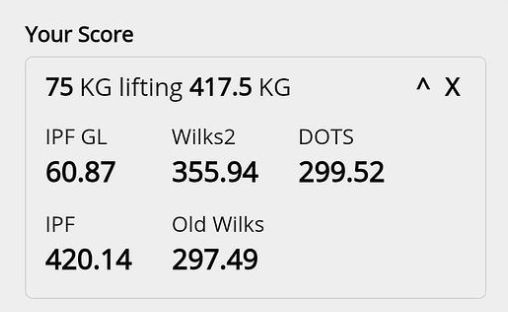
My weight class has a 75 KG limit. As long as I weigh in below that limit, I can compete in the class. That happens to be my average daily body weight, so I could have shown up for the weigh-in and probably made weight (I say probably because body weight does fluctuate day-to-day and it’s easy to be slightly above or below one’s average weight on any given day) without taking any action at all. Let’s assume I did:
My total weight lifted at the Meet was 417.5 KG. At a body weight of 75 KG this would give me the following numerical results:
But since I did a slight weight cut, which I will detail shortly, I actually weighed in at 72.7 KG, which produced these results:
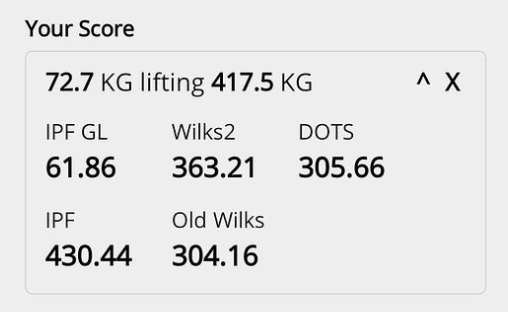
In the Meet itself, I won my division because I was the only 75 KG lifter in the 55-59 year old age group, so my weight had no impact on whether I won or not, but if there was another lifter with the same total, the lighter lifter would be declared the winner. Beyond winning your specific division, there are Best Lifter awards and those are based on the formulas. Additionally, some competitions are set up to award the Top 3 lifters based on the Good Lift points alone. This allows men and women of all ages and weights to compete directly against each other. Lastly, we’ll look at rankings. The DOTS score (DOTS stands for Dynamic Objective Team Scoring System) compares strength performance based on gender and body weight. The DOTS formulas allow a coefficient to be determined by specifying the body weight, which multiplied by the performance provided results in a DOTS point value that is comparable to that of other athletes. It’s arguably the best way to compare best performances among various lifters. My DOTS score ranks me 11th all time in the USPA among my closest competitors, i.e. other Men in the 55-59 age group and 75 KG weight class. Had I not cut weight for the Meet, my DOTS score would drop me to 12th all time. Among all 75 KG lifters of all ages, I rank 2,661 vs. 2,736 had I not cut weight. In all 55-59 year old, 75 KG lifters, Male and Female, I rank 17th (yes there are women stronger than me) all time vs. 20th had I not cut weight. Hopefully I’ve made my case.
Now to get to the actual weight cut. I think the reason weight cutting is not advised for newer lifters unless they’re trying to set some kind of record is because some weight cutting methods can be quite drastic. I also would not recommend them. Wearing a rubber suit, sitting in a sauna, dehydrating or starving oneself to make weight to the point where you need an IV after weigh-in to recover (and this is an actual practice many Powerlifters use) is not advisable. But what I did is nothing like that at all, and allowed me to easily lose almost 3 kilos in 3 days without pain, misery or anguish. The concept is to temporarily lower the amount of stored water and food in the body. This is accomplished by something called a water cut and a gut cut.
The water cut is a simple process of loading the body with more water than it normally gets, thus triggering an increase in urination. You then cut back the water intake the day before the weigh in, i.e. the water cut, and your body temporarily continues the increased urination from the loading phase, thus removing a lot of stored water from your body. When you consider that a gallon of water weighs 8 lbs, you can see how you can drastically impact your weight with this process.
The gut cut was something I hadn’t heard of and found fascinating. I decided to try it for one reason: it doesn’t require cutting calories or carbohydrate intake. Sounds too good to be true doesn’t it? Many weight cutting methods involve manipulating carbohydrates along with the water loading and cutting I described above, and it is remarkably effective at temporary weight loss. Anyone who has tried a low carb diet knows that once they cut carbs they will quickly lose a lot of scale weight, making them think they’ve gotten instantly leaner. This is one of the primary reasons people try low carb diets: rapid weight loss. But it’s not fat loss, it’s water. Our bodies store carbohydrates in the liver and muscle cells in the form of glycogen . For every gram of glycogen stored, we also store about 3 grams of water in the cell. If you stop eating carbs, you stop getting glycogen, your body uses the stored glycogen, and the stored water goes away with it. Combining low carbs for a few days with the above-mentioned water cut, and you can get rather drastic weight loss results. I didn’t want to cut carbs though, as carbs are the body’s primary fuel source and I had a long day of lifting weights ahead of me. If there was a way to cut weight without cutting carbs, I was definitely interested.
The gut cut I did involved eating the same number of calories I typically eat, but using protein powder as my only protein source, almonds as my fat source, and simple, easily digested sugars for my carb sources. What this looked like in practice was protein “shakes” of whey protein powder and water, a bowl of salted almonds and some Rice Krispie treats, rice cakes and Lucky Charms. That’s all I ate for 3 days. You would think I’d be ravenous with that as my only food, but that was not the case. First of all, I ate the same amount of calories I always eat. The almonds are quite filling and all the water I was drinking due to the water load kept hunger at bay. It was an interesting sensation to feel kind of empty inside, because those meals are digested pretty quickly, yet not to feel hungry. Eating like this for 3 days will allow your body to process all the food in your digestive system, reducing your body weight by a few pounds. Once you’ve weighed in and finished the administrative portion of the competition: equipment check, ID, membership verification, providing opening attempts and rack heights for the Squat and Bench, you can eat to your heart’s content as you will have an entire day to nourish yourself with all the normal foods you eat, assuming your Federation uses a 24-hour weigh in protocol. Some Feds use a 2-hour weigh in, which would change things in my mind, but it’s not something I had to worry about.
Now to the Meet itself. The most important thing I did in preparation was to watch several Powerlifting Meets on YouTube in the month or so before my competition. I was able to get the flow of the Meet, understand how the Flights are organized to the point where I was able to guess I’d probably be the 8th lifter in the first Flight (I ended up being 7th, so pretty accurate guesswork), learn the rules, the commands for each lift and what kind of things would disqualify a lift, as well as what the judges were looking for. This removed a significant amount of anxiety and nervousness for me, because I can tell you once you’re at the actual Meet, things move along pretty quickly and unlike your training environment, it’s not an ideal scenario where you dictate your own terms.
The next most important thing I learned, and it was a last minute decision on my part, is to choose a light, easy opening attempt. I saw countless lifters in the competitions I watched choose opening lifts that they struggled with, and most of those lifters went on to have unsuccessful future attempts as each subsequent attempt must be heavier than the prior. You must also consider that there’s no micro-loading so you can’t choose a precise weight you’d like to use. Your attempts have to be in 2.5-KG increments. If you’re an RPE user, most Powerlifting coaches will recommend an Opening Attempt of a 7.5 RPE, but I think that’s too heavy. A 7.5 RPE equates to roughly 90% of your maximum, and your max is probably an estimate to begin with. I was going to use that until I heard an experienced national level record holder talk about their opening strategy. No one cares what you open with, so rather than try to open with something “impressive,” you should consider the opener serving two purposes:
- Ensuring you don’t bomb out of the Meet, i.e. not complete a successful lift and
- Ease last minute nerves and anxiety.
With this in mind, a good rule of thumb is to choose a weight you have recently done for a triple. What I learned at my Meet is that your warm-up routine will not be ideal! There aren’t enough weight plates in the warm-up area to get the exact loads you planned for, and there are lots of people milling about trying to warm up as well. So your opening Squat may be called before you feel you’re actually all warmed up and ready to perform. So it might help to think of your opener as your last warm-up Squat before you try anything heavy. The other thing I learned is that I have to start thinking in kilograms. As un-American as that may sound, the harsh reality is that the barbells and plates are all in KG’s and if you think you’re going to be doing mental conversions in the warm-up area to get the loads just right, you’re mistaken. I ended up basically just doing some sets and reps and hoping for the best, because before I knew it, I heard my name called over the loudspeaker advising me I was 4 out from the platform.
My opening Squat was 122.5 KG, or roughly 270-lbs. I had recently done a triple in training with 267.5 so I felt good that this was easy weight I could lift under even the worst circumstances. As it turns out, I was back in the warm-up area to wait for my second call-out before I even realized what hit me. I just got under the bar, and my body did what it always does since I practice all my Squats just as if I was doing them in competition. I highly recommend that strategy so that your brain knows what to do without giving it much thought. My opening Squat just happened, I got 3 White Lights, and walked over to the podium to provide my second attempt. You must have your attempts in mind before the competition. Do not count on Meet Day to go by feel. There’s too much going on, people in the audience, music playing and lifters continue to make their way to the platform, so you’re not going to be doing much thinking.
I made a pretty good-sized jump for my second Squat, as I had 3 primary goals for this Meet:
- Go 9 for 9, i.e. successfully complete all three attempts at all three lifts.
- Squat something that started with a 3 as in 300-lbs, Bench something that started with a 2, Deadlift something that started with a 4 and
- Don’t die.
So for Squat number 2, I picked the closest KG version of a 300-lb squat and headed back to the warm up area to wait. I was much less nervous for my second attempt, and here’s another tidbit for any competition neophytes reading this. Take your time. They will call your name and let you know the “platform is ready” , or that the “bar is loaded” depending on the Federation. There’s a 1:00 minute clock above the display behind the Squat rack and that’s how long you have to set up and get in position to get the Squat command. One minute may not seem like much time, but it’s plenty. Wrap your wrists and adjust your belt while you’re On Deck as there is no adjustment on the platform. My second Squat felt a little heavier than I expected and my quads made their presence felt as I strained through the sticking point. I hit it just fine and got 3 White Lights, but it told me that I wasn’t as warmed up as I typically am when I go for heavy singles. So I made sure to keep moving around in the warm-up area before my final attempt and forced myself to drink some of my Pedialite/Water/BCAA concoction I had prepared.
For my third and final Squat, I chose a weight that was just slightly less than my estimated max. Since my #1 goal was to hit all my attempts, I played it conservatively. It was a challenging lift, but I completed it and got 3 White’s for my 142.5-KG third and best Squat of the day. I felt great heading back to the warm-up area knowing I had performed well and now had plenty of time before I would have to Bench Press. The entire second Flight still needed to Squat, so I forced myself to eat some of the food I brought with me. I got my Meet Day nutrition advise from the Strength Academy podcast and kept it simple and easily digestible. I had some protein chips, rice krispie treats and jelly beans and then relaxed until we were told we had about 20 minutes until we started the Bench Press.
I repeated the process I did for Squats; i.e. warming up the best I could and choosing a very easy opening attempt. Even though I had practiced my setup many, many times, I didn’t get it quite right for the Bench. It’s my weakest lift and the one I have the least confidence in. I think I rushed a bit so I got very little leg drive and didn’t have as much of an arch as I get in training. Just like my first Squat, it was over before I knew it and I found myself back in the warm-up area wondering what had just happened. I tried to stay focused and was a bit better for my second attempt, but it felt a little heavier than I expected, and led to my only error of the day. I knew what I wanted to go for on my third, but because my second felt a bit heavy, I should have come down 2.5-KG’s for the third. I did not, and my attempt at a 97.5-KG Bench was a complete bust. I got it off my chest and that was it. I have since determined the likely cause was an overestimated one rep max because my plates at home are not calibrated. Even though I thought I had benched 215-lbs in the Garage Gym Competition in May, as it turns out it was really 209.4 lbs (I weighed all my plates and the barbell I used for the Garage Gym Competition a few days after my Meet). If the plates you’re using aren’t competition legit, calibrated plates, they probably don’t weigh what they claim to weigh!
It was hard to let go of the missed Bench and it really took a lot of the motivation out of me that I had felt coming out of the Squats. But I rested, ate some more and eventually started milling around the warm-up area trying to warm up for Deadlifts. This was the hardest lift to warm up for because of the lack of plates, so I ended up just doing a bunch of singles, doubles and triples with whatever weight someone had on a barbell and tried to focus on my technique. My recent SI Joint pop was fresh on my mind and I was intent on not getting hurt, while still meeting my goal of a Deadlift that started with a 4.
I opened light again, and it felt easy and was awarded 3 White Lights. For my second, I chose a load I’d done at home many times and again, I pulled it with relative ease and got another 3 White Light lift. Fatigue was definitely a factor as I walked over to the table to call for my third attempt. For a split second, I almost called for something just under 400 lbs, but based on how easily I pulled 385 for my second, I decided I was not going to be denied. I called for 182.5 KG’s or roughly 402-lbs. I didn’t psyche myself up, yell and scream or snort ammonia. In fact, I intentionally stayed calm and even closed my eyes a few times while waiting in the hole, and then on deck. When they called Platform Ready for me, I slowly approached the bar and did my entire setup carefully, slowly and was actually able to do something I hadn’t been able to do all day: concentrate. It was my best lift of the day and while I felt a little lightheaded when I put it down, the 3 White Lights brought a smile to my face as my day was done and I didn’t die. In fact, I achieved two out of three goals, which as the sage and eminent philosopher Meatloaf sang long ago, two out of three ain’t bad.
I was met on my way back from the platform by a young man who had been lifting in my flight, along with his girlfriend and it appears they had been cheering for me the whole Meet. There aren’t many 57-year old Powerlifters, so I think they were impressed and we chatted a bit about lifestyle choices to ensure you age well, rather than fall to pieces before you reach Social Security. I packed up, and went out to the audience to eat the rest of my snacks and watch the big Deadlifts that followed and thoroughly enjoyed being part of the scene, having my name called as the winner of my division and receiving my trophy. I could finally say I was a Powerlifter, rather than just a guy who trains for powerlifting.
I took two days off from lifting, and then started training for November 20th when I will again don the singlet and head to the platform looking to improve on my results. Here’s video of each of my successful lifts from the USPA Holy City Armageddon Powerlifting Competition July 24, 2021. You can also see some pictures on my Instagram. As I’ve reflected on it, I think I’m most pleased with the fact that all of my successful lifts received 3 White Lights. There wasn’t a single Red Light from a judge in any of my lifts, and that’s something I take pride in.
 Joe's Blog