I’ve undoubtedly scribbled numerous times about my age and how unlikely it was I could still force my body to create new muscle. I know I’ve mused about this recently in light of the lack of access to a proper gym and being stuck at home training with resistance bands and body weight. Almost as if someone heard me, my hypertrophy mentor Menno Henselmans posted a new article breaking down the research on aging and muscle growth and wouldn’t you know it, age doesn’t matter to your muscle tissue.
Here’s the conclusion of one study among masters athletes up to 81 years old:
This study contradicts the common observation that muscle mass and strength decline as a function of aging alone. Instead, these declines may signal the effect of chronic disuse rather than muscle aging. Evaluation of masters athletes removes disuse as a confounding variable in the study of lower-extremity function and loss of lean muscle mass. This maintenance of muscle mass and strength may decrease or eliminate the falls, functional decline, and loss of independence that are commonly seen in aging adults.
There’s a lot of great information in that paragraph, but not specific to my most pressing concern, which is whether or not I can build more muscle.
In this study, eight young men (age 20-30 years), six young women (age 20-30 years), nine older men (age 65-75 years), and ten older women (age 65-75 years) were put on a weight training regimen of 3 full body sessions per week for 6 months. The conclusion was inspiring:
Thigh and quadriceps muscle volume increased significantly in all age and gender groups as a result of strength training. The results indicate that neither age nor gender affects muscle volume response to whole-body strength training.
That’s one in my column!
This was a fascinating study that looked at both muscle growth, and muscle loss as a result of detraining:
Eleven young men (25 +/- 3 years, range 21-29 years), 11 young women (26 +/- 2 years, range 23-28 years), 12 older men (69 +/- 3 years, range 65-75 years), and 11 older women (68 +/- 2 years, range 65-73 years) had bilateral quadriceps muscle volume measurements performed using magnetic resonance imaging (MRI) before and after strength training and detraining.
RESULTS:
A significantly greater absolute increase in muscle volume was observed in men than in women, but there was no significant difference in muscle volume response to strength training between young and older individuals. In addition, there was a significantly greater loss of absolute muscle volume after 31 weeks of detraining in men than in women, but no significant difference between young and older individuals.
CONCLUSIONS:
Aging does not affect the muscle mass response to either strength training or detraining.
That’s two for me.
In this study, after 16 weeks of resistance training, gains in muscle mass, type II myofiber size, and voluntary strength were similar in young and old subjects. In conclusion, at the level of translational signaling, we found no evidence of impaired responsiveness among older adults, and for the first time, we show that changes in translational signaling after unaccustomed resistance exercise were associated with substantial muscle protein accretion (hypertrophy) during continued resistance training.
In summary, contrary to our hypothesis, translational signaling responses to unaccustomed RE were not blunted in older adults, suggesting the protein synthesis machinery is relatively intact and reasonably responsive among old. Further, young and old experienced similar magnitudes of myofiber hypertrophy, which appeared largely by protein accretion based on myonuclear domain expansion.
That’s three, and what I love about this study and science in general, is that they readily admit the evidence contradicted what they assumed would be the result.
I feel rejuvenated and inspired to forge ahead with confidence that my efforts may do more than just maintain what I’ve built, but possibly eke out a bit more. We know we can’t just build as much muscle as we want, as the body has a limitation probably controlled by myostatin levels which is a genetic component we can’t alter yet. The only downside to this is that now I feel even more desperate to get back to a gym where I can more easily monitor and adjust the load I’m training with to optimize the results. But for now, not coming down with COVID-19 takes precedence over increasing biceps size.
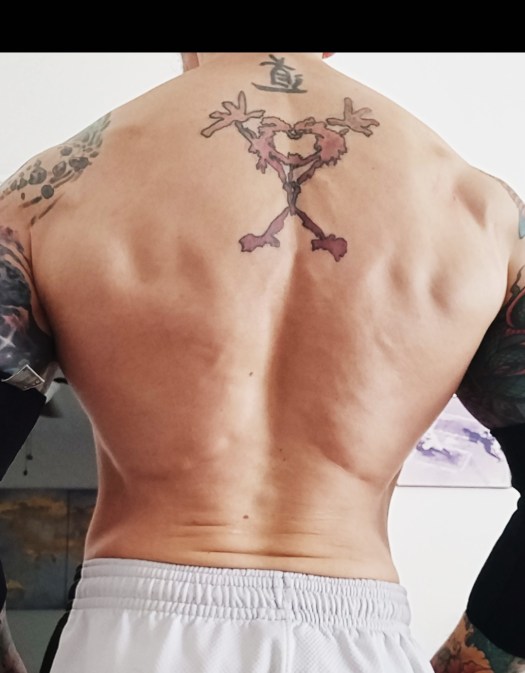
Since I was thusly inspired, I took a couple of selfies as I was training chest and back today. Not your average 56-year old man I’m bold enough to say: